
Similarity in the Celestium
Today’s thoughts on similarity (inspired by Christmas friction):
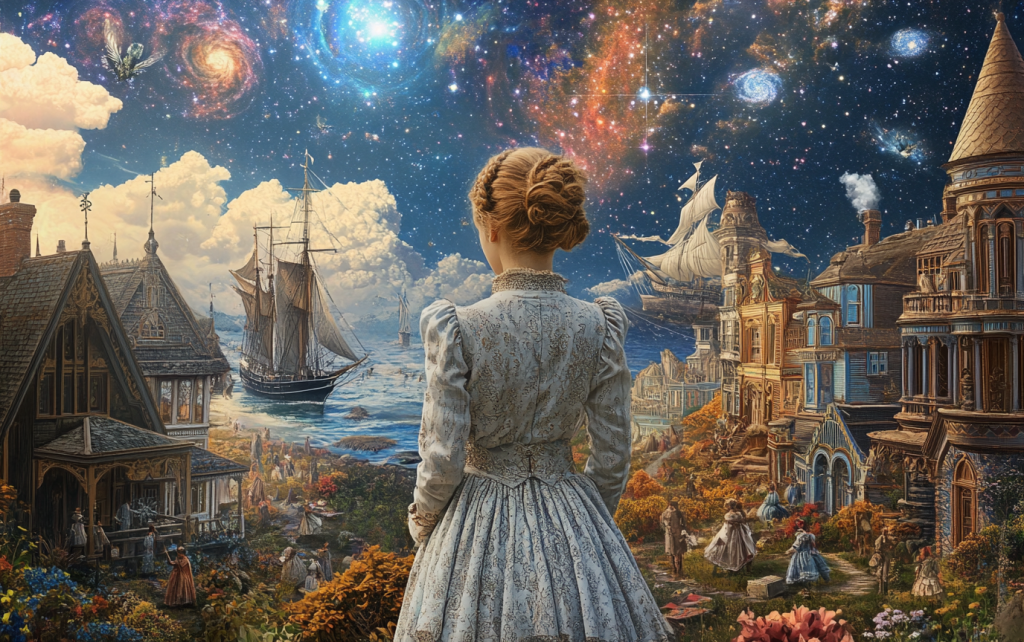
One of the diarists of the Salt Island Diaries, Clara, describes her visits to a heavenly dream-world. That heaven is part of a larger celestium where awarenesses of every conceivable type exist. In the vastness of possibility, very similar things huddle together. Awarenesses that are attracted to similar awarenesses form poles of attraction. These are heavens, for lack of a better term.
Awarenesses that are annoyed by similar awarenesses do not form heavens. However, they cannot escape the huddling: what it means to be in a reality is to share it with other awarenesses that are similar enough to perceive it the same way.
Realities are shared, or they are not realities — the latter are madnesses. And if realities are shared by beings who frustrate each other, they are hells.
Unfortunately, there are always more potential hells than heavens. This is due to the fact that there are more ways for things to be faulty than to be functional, more ways to be disharmonious than harmonious. Two paintings can be identical in exactly one way — perfectly — but they can be dissimilar in a nearly infinite number of ways. There is one way to assemble a given watch such that it works, a mind-boggling number of ways to assemble it such that it does not work. The possibility for mismatch only increases as complexity increases.
Therefore, any consciousness complicated enough to think about similarity is going to perceive much more disharmony in the celestium than harmony. That is logically unavoidable. Wherever there is complexity, there is dissimilarity, and there are simply more ways for dissimilarity to be disharmonious.
There is so much hell, there is a temptation to consider Hell the default condition. Heavens seem to be idealistic fantasies, incongruent with possibility, when they are, logically, merely rare.
By visiting her heaven in dreams, Clara begins to understand her task in waking life. Nineteenth century New England is one of the many hells possible, but she understands that Heaven is not a holy place, it is holiness of attention. Heaven may be practiced anywhere.
> Awarenesses that are attracted to like awarenesses form poles of attraction (heavens).
An alternative theory: perhaps awarenesses can be too similar. Opposites attract, so they say; or, conversely, likes repel. I never understood the former, but I can recognize the latter. Too much similarity might be a barrier to success, whereas if you are slightly less similar — at least dissimilar Macken — it might be easier to work together?
> Opposites attract, so they say; or, conversely, likes repel.
That’s why your former lovers were all short, fat, stupid, and slovenly — religious fundamentalist, Tory, racist, misogynous… No, really, one has to do with similar people, but makes much of the residual differences.
You might be wondering why dominant people attract submissive people. It’s rather that they repel everyone else. Submissive people are otherwise fine with watching television and eating snacks. They don’t pine to be pushed around (BDSM is obviously a special case). When they do pledge fealty to a dominant person (usually to resist a less preferable domination), it’s not a pole of attraction. It’s some organization that operates by coercion. It is no heaven.
The folk wisdom of “opposites attract” is a fortune cookie that one receives in a hell. Why? Tidy people do not adore messy people. Tidiness is rather a point of friction. “Opposites attract” really means that people are so complex and multi-faceted, that one is unlikely to to find a match across all dimensions. Where there is a difference, there is something opposite, contrary, in opposition. And therein lies the difference between a heaven and a hell. In a heaven, non-functional differences are orthogonal, not oppositional.