
Consent
Many things happen in the dream world, everything imaginable, except one thing: predation. Everything that happens, happens with the consent of the participants. This is not an arbitrary rule of a magical world. This is a logical consequence of freedom. If everyone is free to leave (wake up), then all those still present have signed up for what is going on.
Once you see what consent means in the dreaming world, you cannot return to your old ideas in the waking world.
Below are two excerpts from The Wraiths of the Thames, which I think do a better job of explaining consent than an essay could.
This is also, in my opinion, an example of dream guide humour. The dream guide, Amanda, is annoying the narrator while warning him against being annoyed. She explains how annoyance is a perversion, taking delight all the while that the explanation itself provokes outrage. The narrator is consenting!
This dialogue is a fabrication on my part, other than the fact that I got the content from dream guides and the fact that Amanda is based on a real dream guide.
From Chapter 2
[ … ]
During the train ride north, we spoke much of her friend, whose ticket I had been given. It seems that she had been so long without sleep, she ended in a sanitarium. Her nightmares were such that she became unwilling to sleep, and had developed an array of neurotic habits to fend it off.
“She dreams of creatures who try to feed on her life force,” Amanda said.
“Like vampires?” I asked.
“Vampires drink blood. These creatures feed on emotional energy. For example, she arrives at a university class only to discover that she has forgotten that an exam is being given that day. Or, she gives a public talk, only to discover that behind the podium, she is nude from the waist down. Perhaps she finds herself in a confessional booth, only to discover that the door is locked and the divider has disappeared. Always, there is some emotional plight, and some character who is excited by it, and perhaps has even engineered it.”
“These are just dreams. Why is she so upset?” I asked.
“She believes her dreams are real, and that they allow her to see what is actually happening to her in a spirit dimension.”
“How so? The next day, she wakes up and life goes on as if nothing happened.”
“Yes, that’s exactly the problem.”
”What is the problem?” I asked, slightly annoyed.
“She wakes up and life goes on as if nothing happens.”
“Yes? So? Yes?”
“I admire suffragists, you know, getting the vote for women. Organising, writing, speaking, pamphleteering… all that atop of the ordinary requirements of life.”
“What does that have to do with your friend?”
“Nothing.”
“So why are you suddenly talking about suffragettes?!”
“Well, she’s just the kind!” Amanda exclaimed with mock consternation. “But the ordinary requirements of life are all she can manage at the moment. Do you see? What if every human had the wherewithal to change history? You know, not every suffragist is intelligent and talented. Some are simply hard-working and dedicated. What if it were within everyone’s means to simply matter?”
“You’re saying most people have emotionally draining dreams? And that being historically irrelevant is some kind of … symptom?”
“What do you think? Before you form an opinion, let me warn you: hers got her locked up.”
“Well, presumably, she is in a place where she can get the care she needs.”
“Oh, yes, indeed. Many people presume that.”

In Milton Keynes, the locomotive of our train was exchanged, for technical reasons not announced. We were delayed forty minutes. I wasn’t sure whether we would need to transfer, but I was reluctant to ask something I ought already know. Amanda held both tickets, so it was impossible to figure it out on my own.
When we finally reached Birmingham, we ran to the main hall of the train station, where Amanda consulted the master schedule.
“Oh, dash it!” she exclaimed. “We’ve missed the last train!”
“Now what?”
“I don’t know. Say, we could visit your ticket owner!”
“I’m not sure that is exactly—”
“She’s not in a proper sanitarium, you know. It’s an estate house in Runnymede. Many of the residents are simply boarders.”
“Yes?”
“It’s rather like a hotel. You might like it. As a lieu de détente.”
“I think I’d rather relax at home.”
“The female patients rarely see men who are not their doctors. You would be something of a celebrity. What do you think? I might make a little money. You wouldn’t mind, would you?”
“Money? For what?”
“Entertainment. They are so keen on it. And grateful. You see, their lives are purposefully kept monotonous.” She leaned toward me and in a low voice said, “Of course, if they like you, I would show my appreciation.”
I began to suspect that Amanda had interests and connections that were not at all appropriate for a woman of her class, whatever that might be. I had the keenest intuition that it was not in my interest to have any part of it.
“Oh, you’ll pout now,” she moaned. “Do not pout, or I shall disappear in an instant. You must be a brave fellow.”
“Come.” She took my arm in hers. “I will return you safe and dry to your monotonous little boarding house.”
During the return trip to London, I found it nearly impossible to refrain from asking her about the sanitarium, with the hope of indirectly discovering what she did there during her visits.
“What is the routine there for your friend?”
“She is awakened at seven each morning — as if that alone weren’t enough to drive a woman mad! Then calisthenics, followed by breakfast. Then warm water baths; she is melancholic, you see, and must pass several hours per day in warm baths.”
“It really doesn’t sound so bad. I was rather imagining that the patients were strapped to rotating wheels or something.”
“Yes, it is not so bad, physically. But here there is the question of agency. They sedate her each night. Then the dreams continue. When one cannot choose her own experiences, her life belongs to whomever does. I think this is the matter. I would find it maddening — which I suppose would make me an excellent patient!”
“Even if she is made to sleep,” I began, ”— and I honestly do not see the alternative — who else is responsible for her dreams? The doctors cannot be blamed for that! Perhaps she does choose her dreams, merely perversely.”
“I think she is a pervert,” Amanda replied, and with such satisfaction and finality, that I found myself unnerved.
“You don’t find that problematic?” I asked.
“Who among us does not enjoy a good spanking from time to time?”
“I most certainly do not!” I protested.
“To be spanked is to be set free. Who does not wish freedom?”
“I see that I really don’t know what you mean by ‘freedom’.”
“Whoever spanks you has, or claims to have, authority over the situation that inspired the spanking, no?”
“I suppose…”
“Something went wrong, and now the authority is issuing a correction, yes?”
“Yes.”
“With authority comes responsibility, yes?” she asked.
“Yes.”
“You sin, but someone else has the responsibility for ‘correcting’ it. You are spanked, and the matter is closed. As long as a spanking is offered, and as long as it is accepted, you are not responsible.”
“Of course you are responsible! That is why you are spanked!”
“We just agreed that it is the spanker who takes responsibility. Which is it? A carpenter, who sells a broken table, is not spanked. He takes responsibility, and that means, he must fix the table. Where there is a spanker, there is a transfer of responsibility. This seems to me quite obvious. No responsible person spanks himself.”
I felt quite flustered. Her argument seemed to be logical, yet simultaneously contrary to all common sense. “Have you been spanked?” I asked. “I find myself wondering how many people could consider you a responsible person.”
She put her elbow on the window ledge and rested her chin on the back of her hand. Looking up at me, she batted her eyelids. “You might say, I have been the object of much interest and concern.”
From Chapter 7
I found myself standing in front of a three-storey townhouse. Predawn light was just appearing at the far end of a residential street, otherwise devoid of life.
I did not panic. I had the sense that I had done this before, or at some earlier stage of the game, I had chosen to do this.
I wondered whether a friend lived at this house, or whether it was a house known to me in my childhood. There seemed no way to know other than knocking.
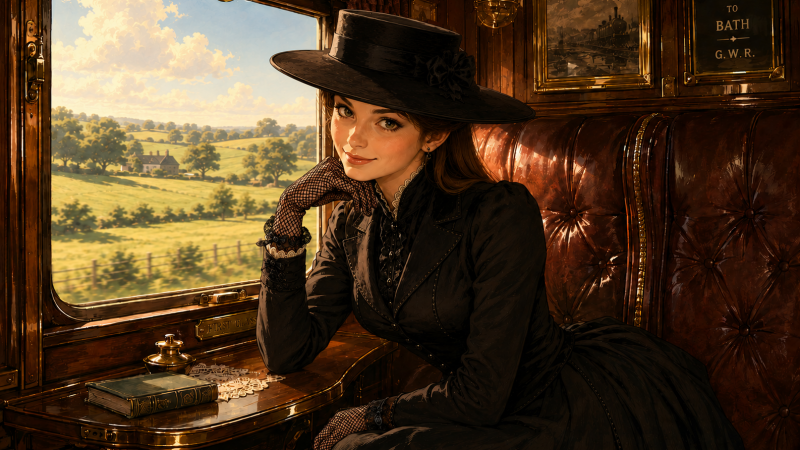
A woman approached me from my right. She wore a tight-fitting broad shouldered jacket and a long straight black skirt. She had a stylish canted broad-brimmed hat adorned with an ostrich feather. Somehow, I hadn’t noticed her approach before she was an arm’s length away.
“I knew I’d find you here,” she said with a fatigued tone.
“What is this place?”
“The last place you want to be.”
“Thanks…? I think I’m having trouble remembering… How do I know you?”
“I’m your friend, but you find me unlikeable. You’re difficult that way. Actually, in many ways. You know what? ‘Friend’ is not the right word.”
“I’m sorry.”
“I know.”
We stood, looking at each other some long seconds. Finally, she asked, “Do you want to come with me?”
“How do I know I can trust you?”
She smiled. “It’s not a problem. You’re very foolish.”
“Actually, you do seem familiar…”
She took my arm and led me away. “Let’s go this way.”
“Where are we?”
“This is a dream world,” she said. “Maybe the best.”
“What makes it so good?”
“Every possible abuse and torment is available here, connected by a very good tram system, and at the end of the day, excellent clubs and hotels. There are not many configurations of civilisation that can combine all these things.”
“Are you one of them? You know, the abusers?”
She stopped and turned me to face her. “There is something you need to know about this place, the most important thing: Everything that goes on here is by consent.”
“Even the abuse?”
“Especially the abuse. Abusers come here because they have low opinions of themselves and they need to elevate themselves above some one. Victims come here because they have low opinions of themselves and are weary of the responsibility. Most of them are lying to themselves about what they are doing here, but that has nothing to do with their consent.”
“How do you know they are lying?”
“Abuse is never justified or necessary. It is a luxury of the wicked. It is the luxury of the wicked.”
She help up an arm to hail an approaching cab. “We are free here,” she said to me. “Everyone is free. This is what freedom looks like, that’s all.”