Hell
The concept of hell comes up often in my writing, but I’ve never explained the concept in one place before.
When I write about hell, I never mean it in a religious context. Hells are psychological, and because they are psychological, they exist in dreams as places. That is why we need to take them seriously. We need to recognise when we are in one so that we might quit it.
Here is the definition. It is simple: A hell is a self-justifying feedback loop — just as a heaven is — but in this case, it is a pernicious feedback loop.
A drug addiction is a hell. You get high to avoid some unpleasant feeling, and for a brief moment, you feel very much better. But it doesn’t improve your original situation and later comes around as withdrawal. Now you have two bad things instead of one. The solution? More drug.
It is said that war is hell, and it is truer than you might think. A foreign country attacks your country and now there is an armed conflict. If your country wins, it because its leaders are good at solving problems with violence. You end up in a post-war society that is solves problems with violence. Laws do not list rewards for good behaviour; they detail the punishments for bad behaviour. This is what it means for a society to be dark.1 The only way they can avoid that label is to destroy less dark societies.2 That’s the feedback loop.
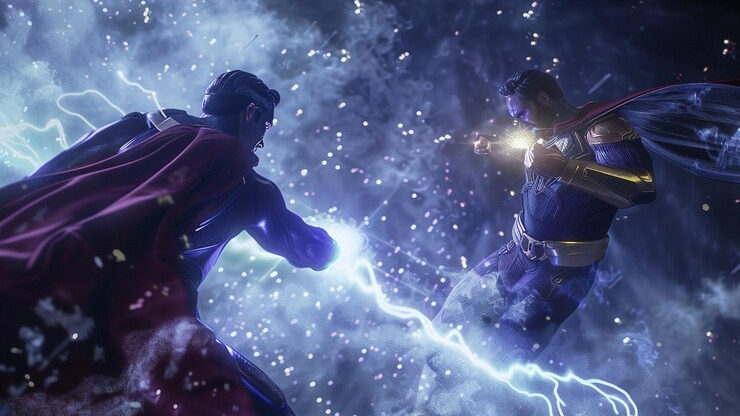
Let’s move on to the less obvious. Much of what we consider entertainment celebrates and normalises hell. Stories about heroes defeating villains are hells. Think about it. Everything that goes on in such a conflict is unpleasant. There is a lot of stress and violence and anger and just bad things in general, ending with a defeat. The ‘good guy’ ultimately defeats the ‘bad guy’, although it is rather like the less bad guy defeats the more bad guy, because they are both addicted to violence. That is entertaining.
But wait. There’s more. Although Western history is quite nearly filled to the brim by rotten behaviour and conflict, it evidently does not provide enough. Fictional stories of conflict are fabricated to satisfy market demand — because there isn’t enough violence and conflict in ten thousand years of civilisation, that’s why.
In the fictional world, there are super-villains, capable of super violence, and super-heroes, also capable of super violence. Because ordinary violence was not enough. You’d think that after the first super-hero story, people would have been satisfied. No. Super-heroes are a genre.
But wait. There is more. There are even horror movies. These are for depictions of cruelty that exceed what reality can offer. You’d think that horror movies would be used to punish criminals or political dissidents. No. Ordinary people pay to see them.
This is what it means to live in a dark society. Anyone who can get good with this cannot get good with dreaming. The reason is that such a person dreams of conflict, and conflict is a loop that accomplishes nothing. This is basement-level dreaming of no merit. The dreaming world has much more to offer.
Footnotes
1. Consider that scientists are not punished for writing bad grants or bad articles. The worst that can happen is that they should be ignored.  Reward-based control is conceivable.
2. Consider these "threats of a good example:" Cathar crusade (1209), UK-US (1776), European monarchies-France 1792, US-Vietnam (1965),US-Chile (1973), US-Nicaragua (1981), Russia-Ukraine (2020)