
The Shakers
I want to write about Shaker Heaven, but a little introduction to the Shakers is necessary first.
Click here to jump to Shaker Heaven.
Introduction
The Shakers were a Christian communist cult that started in England in the mid-18th century and which experienced its heyday in the first half of the 19th century in the US. They were known for their ecstatic religious services (from which they got the “Shaker” name) and for their craft work.
They did not call themselves Shakers, but rather, the United Society of Believers in Christ’s Second Appearing. They believed that the founder of their US order (Anne Lee) was the female incarnation of Christ, and their mission was therefore creating Heaven on Earth.
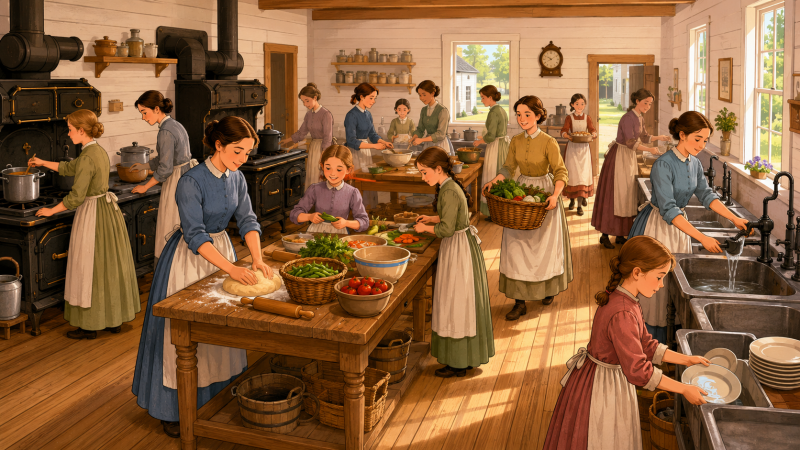
Shakers lived in large dormitories on sprawling campuses. In addition to agriculture, Shakers engaged in wood work and crafts, using state of the art technology. Some of those innovations were Shaker inventions. For example, they developed the technology for water-powered wood-working tools. Their buildings had running water far earlier than the mainstream world.
Craftwork
The least interesting aspect of the Shaker’s legacy is what they are most famous for: their manufactured products. In particular, their furniture and storage boxes became wildly popular, and command high prices even today.

Their furniture had simple and clean lines, an aspect that would be highly appreciated in the future. The lids of their storage boxes have lids that fit as tightly today as when they were made. Closets were built into the walls — an unusual practice for the time — in order to eliminate places for dust and dirt underneath the closets.
They also had a catalogue business that revolutionised seed-selling in the US.
The high quality was a side-product of their religion. They sought to perfect their attention as a religious practice.
As the industrial revolution wore on, Shaker handcrafts were no longer competing against other handcrafts, but against factory products of reasonable quality at vastly lower prices.
Gender equality
As Shakers considered their founder to be the female incarnation of Christ, gender equality was inherent in their religion. For each position of power, there were male and female leaders. Lucy Wright, a turn-of-the-century Shaker leader, exercised power over both men and women, an unheard of phenomenon at the time.
Labour was nevertheless separated along traditional gender lines: Agricultural and industrial work was done by men, while women performed domestic chores. Added to that were some of the Shaker hallmarks: seed and herbal packaging.
Gender equality inequality
For a (non-Shaker) 19th century farm wife, days were long, and work was done either in isolation or with children. Any property she had became the property of her husband. She was expected to be obedient to her husband. Alcohol consumption was quite high among men. None of these features made a farm wife’s life enviable.
A Shaker woman similarly worked long hours, had no property, and was expected to be obedient. However, she had female leaders to obey. Her work was done in the company of other like-minded women. There was no alcoholism. In other words, the Shaker lifestyle was for a woman in most ways better than the life she could expect on the outside. Accordingly, women disproportionately filled Shaker ranks. Women of child-bearing ages outnumbered like-aged men 2 to 1, and often 3 to 1.
Men’s situation was the opposite. They did the same work that men outside the Shaker campuses did. They faced all the same hardships and dangers, without the compensation of property or of a warm shoulder at night.
There is little reported strife in Shaker communities, but most of occurred had to do with resentment of the status of women.
Celibacy
The Shakers observed strict celibacy. There is no hanky-panky in Heaven, so that would have to be foregone by any serious applicant. Perhaps it is a coincidence that the founder had four children and lost them all, due to reasons not in the historical record. Needless to say, she was sour on motherhood before she became the female incarnation of Christ. But no matter, everyone knows angels do not wonder what splendor lies under each other’s skirts, so there is no need for discussion.
I see the following unsubstantiated entry in my notes, made years ago:
I read that most converts were young women and teen-age girls. I would have expected widows and spinsters, but it was instead those at the height of their attractiveness and options. My hypothesis is this: women at the beginning of the 19th century would have known quite a lot about domestic and sexual abuse, either as witnesses or victims. Some of them must have recognized celibacy as a way out of that world of torment.
In the first half of the 19th century, intense female friendships were considered healthy and natural, but fundamentally girlish and unimportant. Given that the Shaker sisters slept two to a bed, there would have been opportunities for intense friends to become bedfellows. I can only guess that it was an open secret among those ‘girlish’ women that celibacy meant abstinence from heterosexual contact. I read that in at least one of the campuses, young women were assigned to multi-generational bedrooms of half-dozen women, and I can imagine this to be an attempt to discourage them from testing of the definition of celibacy.
Children
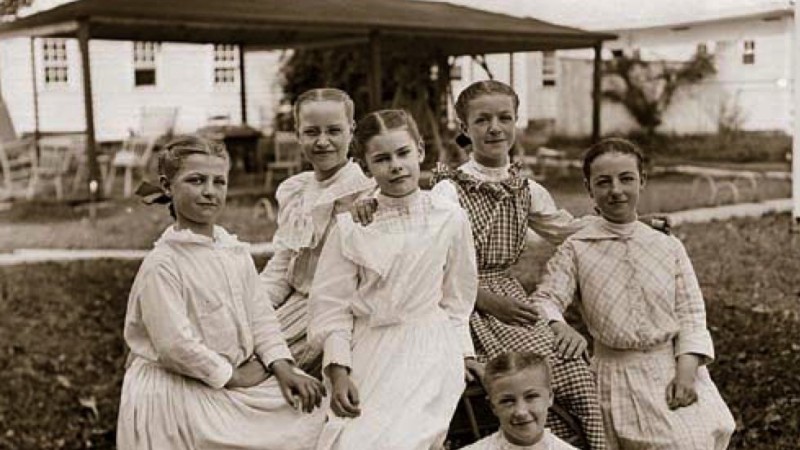
As a celibate order, there was little possibility of transmitting their religion as most religions do — with pants around ankles. The Shakers therefore took in orphans and became a major destination for orphans, due to lack of secular orphanages. It had intrinsic appeal: the quality of Shaker education was unparalleled in their time. Even children who had parents could find themselves sent to live on campus. Children lived in facilities separate from the adults (c.f. Oneida communities) and lived very regulated lives. However, these childhoods were not typical Victorian-era childhoods: they were not subject to corporal punishment — or any type of mean-spiritedness, as this was forbidden by the Shaker religion. Reportedly, Shaker children were granted plenty of playtime. Despite these childhood advantages, monastic life remained a hard sell to children. Shaker schooling produced few converts among the students. If nothing else, their excellent education promised them great advantages in the outside world. Compare this to the Amish, who stop education at age 14, which leaves their students unprepared for the outside world.
As public education improved (often due to Shaker influences) and as the government stepped in to create secular orphanages, the number of children under Shaker care dwindled.
Pacifism
The Shakers garnered quite a bit of mistrust through their refusal to take sides in the American Revolutionary War and later, in the Civil war. They were ultimately granted a federal exemption from military service in 1862, but the PR damage had been done. They were not good Americans. Their reputation was not improved by the influx of temporary male members during the Civil War.
Decline
- Celibacy
- Gender Equality
- Industrial revolution
- Excellent education
- Secular orphanages
- pacifism
- improvement of public schools
These factors put the Shaker’s population in decline, such that there are today more Shaker campuses as museums than there are actual Shakers. I think there were two, as of 2025.

Shaker Heaven
The Shakers sought to implement Heaven on Earth. As far as I know, these are the only people to make any serious attempt at it, so it is instructive to see what this meant for them
Work as a Spiritual Practice
Their motto was, “Hands to work and hearts to God.” To make things perfect was to prepare oneself for Heaven and to honour God. Shaker furniture and storage boxes became highly sought after by outsiders for their high quality and precision fittings.
Shaker cooks took it upon themselves to make perfect meals, pouring all their attention and will into a holy endeavor. Unsurprisingly, the Shakers were known to dine exceptionally well.
Cleanliness
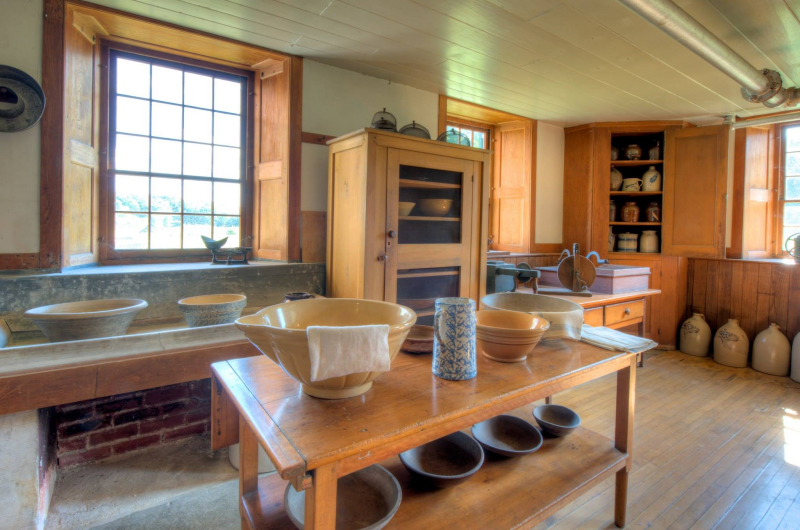
All Shaker property was to be kept clean at all times. The women dusted and mopped tirelessly. The grounds were kept prim and proper. They were very much like zen monks in their zeal for simplicity and order.
It is not complexity of thought that gets you into Heaven, it’s purity of thought.
Kindliness
The Shakers were also known for being very kind. For those who were not kind by nature, there was kindness by dictate. Unlike other Christians, they were forbidden to indulge in righteous outrage.
In a Heaven, one’s presence is optional, and therefore no punishment is needed. It is rather in Hell, where no one’s presence is voluntary, that ill-treatment must be polished up and put into imminent service. It is quite nearly a litmus test.
Raves
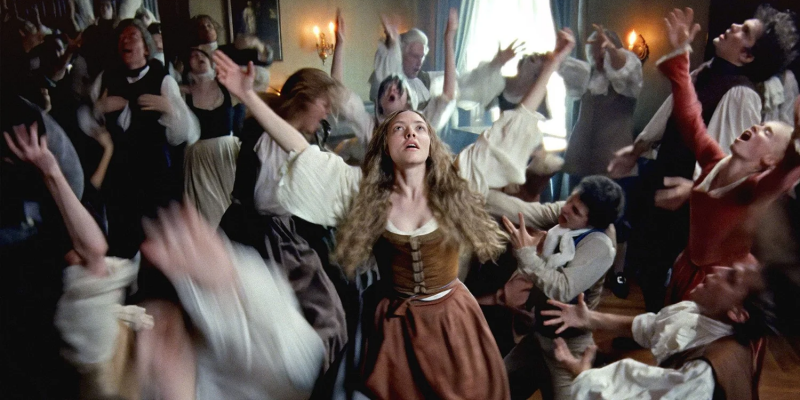
Shakers had religious ceremonies dominated by singing and dancing. In later years, these elements were choreographed, but in the early years, there was a great deal of spontaneous singing and dancing; some people even fell to spasms on the floor. These were signs of connection with the holy spirit or the purging of sin. Some services were no longer than an ordinary religious service. But they did run as long as they needed to. The longest recorded service was 20 hours. One thing is for certain: many Shakers were able to whip themselves up into a delirium and this was the very sauce of the religion; it paid for all other privations.
Teen-age girls were the most ecstatic. In fact, the Shaker revival meetings of the1840s saw them as the dominant force. Having a demonstrable connection to what is holy was a badge of honour, so it is understandable that the most powerless segment of the community would reach for what recognition and power it could.
Unfortunately, the more sedate leadership saw this as a threat to their own legitimacy and clamped down on these manifestations. The religious services became more organised and the dancing choreographed. Teen-agers who in the past would go on to join the movement as adult members began to wander away. Few of the children who grew up with the Shakers after this change elected to stay with them.
If you are interested in the later-year ceremonies, YouTube has several re-enactments. The performers are not Shakers. The people who maintain the Shaker museums are not Shakers. It is fascinating to see how passionate people can be about a religion not their own. Yet they all feel a need to preserve this way of life in the modern imagination. And it seems I do too.