
Heaven is pleasure, and nothing but
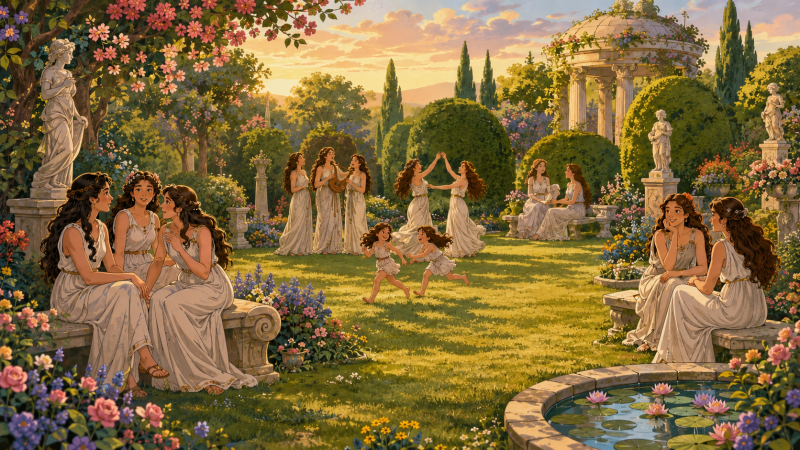
There are dreamscapes that I sometimes refer to as “Arcadian spaces” and other times as “Heaven,” even though I do not believe in a religious heaven. From February 2020 until autumn of 2021, I often dreamt of beautiful, idyllic landscapes populated by calm and beautiful people going about ordinary activities. They were aware that they were in a dream, and therefore, every gesture was a performance, every construction was a work of art. They made their lives beautiful because there is nothing else to do in a dream. They were the servants of the dream. They were also its architects. There was nothing else.
These experiences are easily the most significant of my life. I mean, I think these are the kinds of experiences that have made other people start religions.
I am of a much more sober nature. I think of these experiences in terms of philosophy and psychology. I think about predilections and interests that I have which could lead to a ‘hell‘ or which could lead to a ‘heaven‘.
For example, there are ideas or habits which might be perfectly justified, but which do not service a heaven. Consider the principle of equal pay for equal work. This idea is certainly fair and justified, but it is not how soldiers win wars. They may not bicker about who is entitled to what. The war takes priority.
To dream of a heaven is to have a similar priority. Once in a heaven, one has nothing better to do than stay in it. Any other priority leads to an exit. If you see someone in heaven who does not deserve to be in heaven, there is nothing to be done about it. Any attempt to drive that person out results in you losing your own purchase on heaven, because judgements of worthiness are not heavenly. At best, one is gambling with heavenliness, because there is no such thing as a judgement without the possibility of a negative judgement. To gamble with heaven is to deprioritise it. Thus, a heaven is paradoxically not a venue of fairness, and fairness is not even conceivable.
Therefore, if you manage to find yourself in a heaven — no matter how shabby your state — you’ll be welcomed. They have nothing else to do with you.
This simple, obvious logic, I found mind-blowing. I discovered that I have many ideas and priorities that do not lead to a heaven, and I have had to ask myself why.

My dreams were of a small number of women who were the center of their heaven, and a much larger number of girls who sought to emulate them and learn from them, and to contribute to the beauty of the dream. I at first found it odd that all denizens of heavens were female; it occurred to me much later that the presence of males would have implied a second kind of denizen, but it is the nature of heavens that there be only one. The only difference among denizens can be distance from the center, which, in my perception, was manifest in age.
During these months, I watched them in many dream settings, engaged in various projects. Sometimes they were in arcadian gardens or sunny meadows, just as one might first imagine. Rural settings at different points in history were equally likely. I remember a sunny Mediterranean village whose houses and paths were carved into a mountain that stood directly on a sea shore.
The denizens were involved in play, art projects, or construction projects. I understood that the kind of undertaking mattered little to them — and how could it? They were dreaming. Regardless of what they were doing, how they were doing it was their heaven. Their projects were like songs — beautiful while being performed, but vanishing without a trace once a performance ended. Not coincidentally, they sang. They loved to sing.
This led me to an obvious insight: a heaven is not a place of freedom. When performing a song, one may not make all kinds of noise at any moment. At any given instant, the number of possible harmonious sounds is infinitesimally small compared to what is possible in general. One must be on-beat and on-key. Similarly, there is no personal freedom in a heaven. It can’t be the case that everyone may do anything, because anything includes disharmonious things. The range of acceptable behaviour is quite limited. I don’t mean that anyone is enforcing harmony. It’s simply the case that if you start doing something that is not part of a given heaven, you lose sight of it. By tuning into some incompatible thing, you tune out of that dream.
Therefore, the more beautiful a heaven is, the fewer things that can be done there. That is a consequent of ordinary logic. There is only one way for a thing to a beautiful, and many ways to be less beautiful. If a heaven is beautiful in a different way, it is simply a different heaven. There are multiple heavens.
A wrist watch, for all its complexity, may operate in only one way, or not at all. Any change to a functioning watch leads to a non-functioning watch. There are multiple models of watches.
A further entailment is that the most beautiful heaven is one that is a single event — a single detail. This I also witnessed.
The most beautiful and most awesome kind of heaven is a choir that sings a single note forever, a single note that resonates with every creative and symbiotic force in the universe. It is thunderous, it vibrates, it shudders. It is the orgasm of a thousand angels. It is the most beautiful, awe-inspiring, penetrating event. It is beautiful because it is that one thing.
Such monolithic heavens are inspiring — even soul-shattering — but they are, in the end, unbearable. They are too much pleasure for too long, and the overarching problem is that it is the same pleasure. At least for me. I’m more of an adventurer than a holy person.
Most of my experiences of heavens I had as a child observer. Somehow my adult awareness was incompatible. As a child, I had limited reasoning ability and very few memories to test my reality. I accepted what was going on.
I nevertheless did find the mindfulness it required to be exhausting. One must remain focused on what is happening and one must not wonder about other possibilities. One may not imagine how things could go wrong. To imagine other possibilities is to start dreaming them. It is possible for people like me to stumble into a heaven. But it is hard for them to stay.
In the end, we experience mostly our shabby region of reality because we find heavens too monotonic and too tiring. We are where there is diversity, intrigue, threats, and dangers. By way of illustration: we don’t watch movies about people eating ice cream or skating in a park. That is boring. We watch movies about people facing threats and peril. That is where our attention naturally gravitates. It is our nature.
No one in our world is criticised for having too much pain. Too much pleasure, however, is considered a sign of moral weakness. People who pursue lives of pleasure are considered to be on some degenerate path. It might even be true — but it says something about the nature of this world, not pleasure. Elsewhere in the celestium, pleasure is a holy undertaking of the highest order. It requires enormous self-discipline, clear-headedness, and will. One must be selflessly devoted to the theme of a heaven. Any lapse of attention causes one’s connection to unravel.
Most people who have come to our world are therefore here because it is disagreeable, not in spite of its nature. People who have nightmares, who watch movies that are nightmares, are people who are here for the spanking. They prefer pain because they are the kind of people who manage pain more naturally than pleasure. People prefer what they can manage to what they can like.
Once you have experienced a heaven, and you realise that you’ve stopped, you know what you are.